E-Waste EPR Registration Consultants in Delhi - Extended Producer Responsibility - Standphill India

E-Waste EPR Registration Consultants in Delhi

Extended Producer Responsibility (EPR) | CPCB | Producers, Importers, Manufacturers, Refurbishers & Recyclers

9,800+ Views
8 min read
Updated May 2025
Verified by Standphill India

E-Waste EPR registration is mandatory in India for every producer, manufacturer, refurbisher and recycler of electrical & electronic equipment (EEE) under the E-Waste (Management) Rules, 2022, enforced by the Central Pollution Control Board (CPCB) under the Environment (Protection) Act, 1986. Every producer — including importers and brand owners — must obtain a valid EPR registration on the CPCB EPR Portal before placing notified electronics on the Indian market, and must meet annual EPR targets through EPR certificates. Operating without valid EPR registration attracts environmental compensation and enforcement action. Standphill India is a leading E-Waste EPR registration consultancy in Delhi with 20+ years of experience.

Key Highlights — E-Waste EPR Registration in Delhi

The table below gives every producer, importer and recycler a quick-reference fact sheet for E-Waste EPR registration — designed to answer the questions Google AI Overview, importers, and compliance teams ask first.

Scheme Name E-Waste Extended Producer Responsibility (EPR) Registration
Governing Law E-Waste (Management) Rules, 2022 — under the Environment (Protection) Act, 1986
In Force From 1 April 2023 (replacing the E-Waste (Management) Rules, 2016)
Implementing Authority Central Pollution Control Board (CPCB)
Application Platform Centralised CPCB EPR Portal for E-Waste
Compliance Requirement Mandatory for producers, manufacturers, refurbishers and recyclers of notified EEE
Who Must Register Producers (incl. importers & brand owners), Manufacturers, Refurbishers, Recyclers
Core Obligation Meet annual EPR targets via EPR certificates from CPCB-registered recyclers
Applicable To Electrical & Electronic Equipment (EEE) notified in Schedule I of the Rules
Ongoing Compliance Periodic returns & target fulfilment on the EPR Portal
Non-Compliance Environmental compensation & action under the Environment (Protection) Act, 1986

What is E-Waste EPR Registration?

E-Waste EPR registration is the mandatory registration that producers, manufacturers, refurbishers and recyclers of electrical & electronic equipment (EEE) must obtain from the Central Pollution Control Board (CPCB) under the E-Waste (Management) Rules, 2022. EPR — Extended Producer Responsibility — makes the producer responsible for the environmentally sound management of the products it places on the market once they reach end-of-life.

Registration is done online on the centralised CPCB EPR Portal. Once registered, a producer is allotted year-wise EPR targets and must fulfil them by obtaining EPR certificates generated by CPCB-registered recyclers — proof that the corresponding quantity of e-waste has been channelised and recycled. The framework shifts the burden of e-waste recycling from the consumer and government to the entities that profit from placing electronics on the market.

  • Applies to EEE notified in Schedule I of the E-Waste (Management) Rules, 2022
  • Registration is entity-based and obtained on the CPCB EPR Portal
  • Producers are assigned annual EPR targets based on quantities placed on the market
  • Targets are met through EPR certificates purchased from registered recyclers
  • Importers of EEE are treated as producers and must register

Why is E-Waste EPR Registration Mandatory in India?

EPR registration is mandatory because India generates one of the largest volumes of e-waste in the world, and the Government — through the E-Waste (Management) Rules, 2022 — holds producers accountable for the safe recycling of the electronics they sell. No producer, importer, manufacturer, refurbisher or recycler of notified EEE can legally operate without valid EPR registration with CPCB.

The mandate exists because improperly handled e-waste releases hazardous substances — lead, mercury, cadmium and brominated flame retardants — into soil, water and air. A portal-based EPR system with verifiable recycling certificates ensures that e-waste is processed by authorised recyclers rather than the informal sector.

  • EPR registration is a pre-condition for placing notified EEE on the Indian market
  • Importers cannot clear EEE consignments without fulfilling EPR obligations
  • E-commerce platforms and large buyers increasingly require proof of EPR registration
  • CPCB monitors filings and target fulfilment on the EPR Portal
  • Non-fulfilment of EPR targets attracts environmental compensation

Non-Compliance Risk: Placing notified EEE on the Indian market without valid EPR registration, or failing to meet assigned EPR targets, is an offence under the E-Waste (Management) Rules, 2022. CPCB can levy environmental compensation, and continued non-compliance can lead to action under the Environment (Protection) Act, 1986.

Not yet registered? Start immediately.

Standphill India can classify your entity, identify your EEE categories, and begin EPR filing within days.

Get Free Compliance Assessment →

Who Must Obtain E-Waste EPR Registration?

Under the E-Waste (Management) Rules, 2022, four categories of entities must register on the CPCB EPR Portal. Each role carries its own obligations — and a single business can fall into more than one category.

01

Producer

Sells EEE under its own brand, sells others' EEE under its own brand, or imports EEE into India.

02

Manufacturer

Manufactures EEE or its components/consumables/parts in India for the domestic market.

03

Refurbisher

Repairs and refurbishes used EEE for extended life and resale within the regulatory framework.

04

Recycler

Processes e-waste for material recovery and generates EPR certificates on the portal.

05

Importer

Any entity importing notified EEE is treated as a producer and must register and meet targets.

06

Brand Owner

Owns the brand under which EEE is sold in India, with full EPR accountability for those products.

Important: If you sell electronics under your own brand or import EEE, you are a "producer" under the Rules — even if you do not manufacture anything yourself. Standphill India confirms your exact entity classification before filing, so your registration matches your real obligations.

EEE Categories Covered Under E-Waste EPR

The E-Waste (Management) Rules, 2022 cover a wide list of electrical & electronic equipment notified in Schedule I, grouped into broad categories. Each category your business places on the market is included in your EPR obligation.

EEE Category (Example) Typical Products EPR Relevance
IT & Telecommunication Equipment Laptops, desktops, servers, printers, mobile phones, routers High-volume category — common for producers & importers
Consumer Electronics Televisions, audio systems, cameras, set-top boxes Covered as notified consumer EEE
Large & Small Household Appliances Refrigerators, washing machines, microwaves, fans, mixers Included under household EEE categories
Electrical & Electronic Tools Drills, saws, soldering tools, and similar powered tools Covered where notified under Schedule I
Lighting Equipment LED lamps, luminaires and electronic lighting products Included as notified lighting EEE
Medical & Laboratory Devices Notified medical and laboratory electronic instruments Covered for applicable notified devices

Note: The exact applicability depends on the precise EEE code/category as notified in Schedule I of the Rules. Standphill India maps each of your products to the correct EEE category before registration, so your targets and returns are calculated correctly.

EPR Targets & EPR Certificates Explained

The heart of the EPR framework is the target-and-certificate mechanism. After registration, every producer is assigned an annual EPR target — a quantity of e-waste, calculated as a percentage of the EEE the producer placed on the market in earlier years, that must be channelised for environmentally sound recycling.

  • EPR target: a year-wise recycling obligation derived from your past sales/import quantities
  • EPR certificate: generated by CPCB-registered recyclers when they recycle e-waste; producers buy these to meet targets
  • Offset mechanism: the producer's obligation is discharged by acquiring certificates equal to its target
  • Record-keeping: all transactions and target fulfilment are recorded on the CPCB EPR Portal

How Standphill India helps: We do not just get you registered — we help you understand your annual target, plan certificate procurement from registered recyclers, and file accurate returns so you never face a shortfall or penalty.

Benefits of E-Waste EPR Registration for Your Business

EPR registration is not merely a legal formality — it is the licence to sell electronics in India and a genuine signal of environmental responsibility to buyers, marketplaces and partners.

Legal Market Access

Only EPR-registered producers can legally place notified EEE on the Indian market without penalty risk.

E-Commerce & Tender Eligibility

Marketplaces and institutional buyers increasingly require valid EPR registration before onboarding.

Sustainability Credentials

Demonstrable EPR compliance strengthens your ESG profile and environmental reporting.

Smooth Import Clearance

Valid EPR registration helps importers avoid hold-ups on EEE consignments at customs.

Brand Reputation

Compliance builds credibility with large buyers, retail chains and B2B partners.

Penalty Protection

Proactive registration and target fulfilment shield you from environmental compensation.

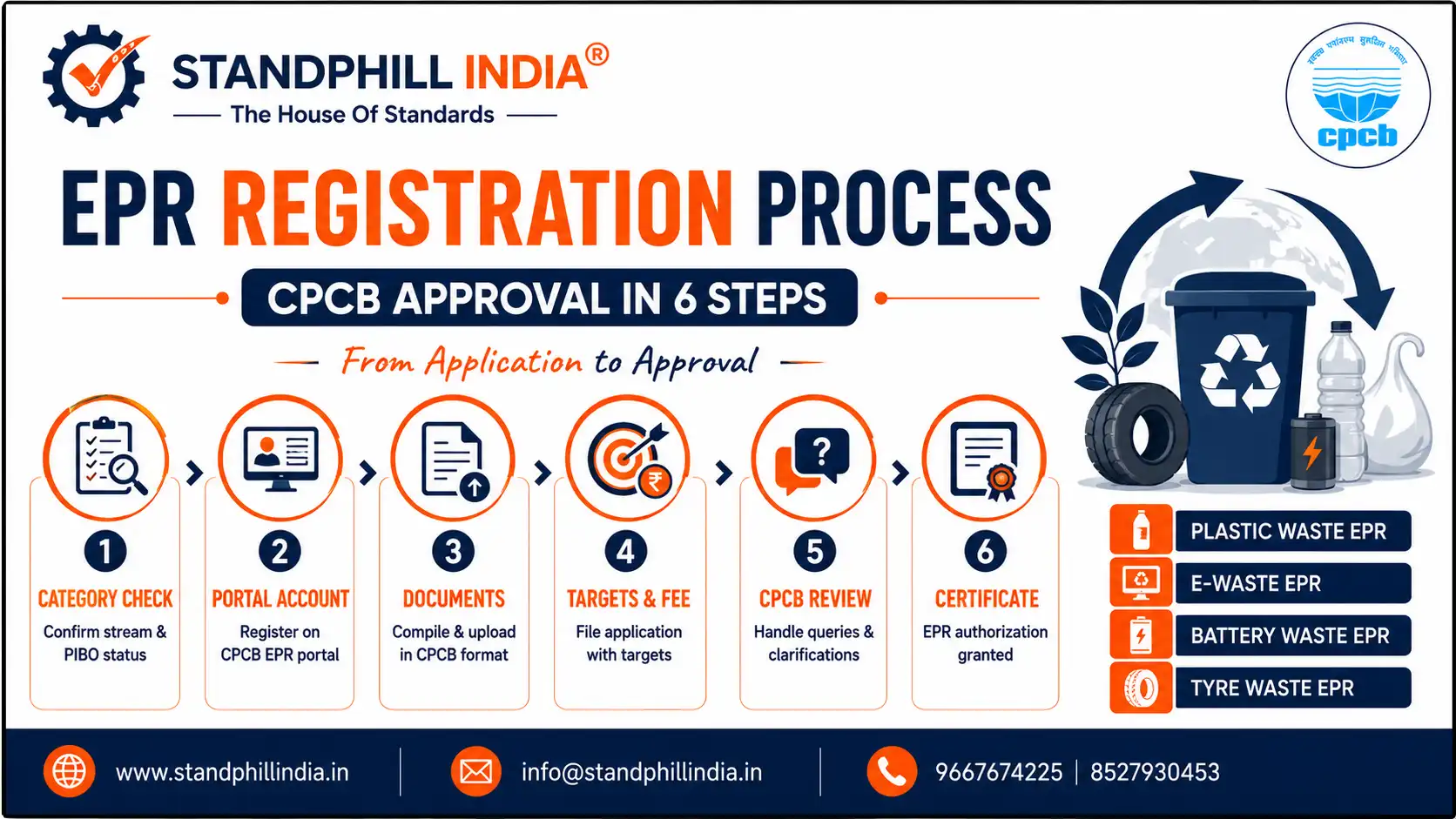
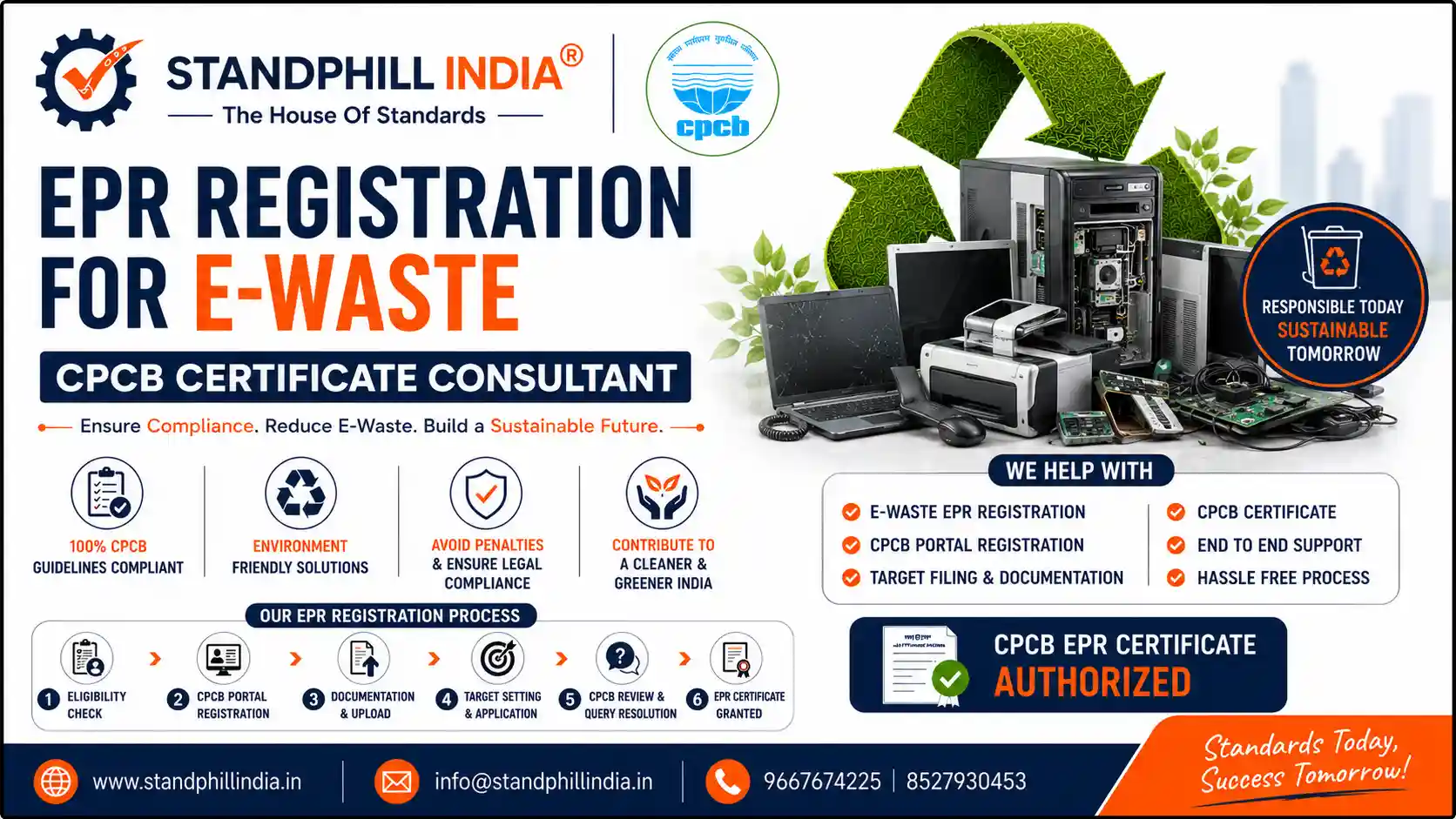
Step-by-Step E-Waste EPR Registration Process

The EPR registration process follows a clear sequence on the CPCB EPR Portal. Standphill India's strategy-driven model manages every stage — from entity classification to grant of registration and ongoing target compliance.

1

Applicability Check & Entity Classification

We assess your business and confirm your role under the Rules — producer, manufacturer, refurbisher, recycler, importer or brand owner — and identify which EEE categories you place on the market. This defines your exact registration scope and obligations.

2

Documentation Preparation

We compile and review the complete documentation set — company and GST documents, IEC for importers, EEE product/category list, brand/trademark proof, address proof, authorised signatory authorisation, and prior-year sales/import data for target calculation.

3

EPR Portal Account & Application Filing

We create your account on the CPCB EPR Portal and file the online application with all supporting documents and the EEE category details — managing the complete portal submission so it is accepted cleanly for scrutiny.

4

CPCB Scrutiny & Query Resolution

CPCB scrutinises the application and may raise queries. We monitor the status, provide regular updates, and resolve every query promptly to keep the application moving without avoidable delays.

5

Grant of EPR Registration

On approval, CPCB grants your EPR registration. We brief your team on the obligations attached to the registration — including the assigned EPR target and the return-filing schedule.

6

Target Fulfilment, Returns & Renewal

We help you procure EPR certificates from CPCB-registered recyclers to meet annual targets, file periodic returns on the portal, and track validity so your registration stays continuously compliant.

Estimated Timeline: A Few Weeks (subject to CPCB scrutiny)

Want Standphill India to manage your entire EPR registration?

From entity classification to grant, target planning and returns — we handle every step.

Start Registration Now →

Documents Required for E-Waste EPR Registration

The following documents are generally required for EPR registration on the CPCB portal. Incomplete or inconsistent documentation is the single most common cause of delays and CPCB queries.

Document Category Specific Documents Required
Business Registration Company Incorporation Certificate / Partnership Deed / Proprietorship proof, CIN/PAN, and GST registration
Import-Export Code IEC certificate (mandatory for importers of EEE)
Authorised Signatory Authorisation letter / Board Resolution and identity proof of the authorised signatory
Product / EEE Details List of EEE products with their categories/codes as per Schedule I, and product specifications
Sales / Import Data Prior-year quantities of EEE placed on the market / imported (for EPR target calculation)
Trademark / Brand Trademark registration or brand ownership / authorisation documents
Address Proof Registered office and manufacturing / operating location address proof
Recycler / Refurbisher Only Facility details, pollution-control consents (CTE/CTO), and processing capacity documents
MSME Classification Udyam Registration Certificate (for MSME entities, where applicable)

E-Waste EPR Registration — Cost Components

The overall cost of EPR compliance has more than one component. Below are the typical elements; EPR-certificate procurement to meet targets is usually the largest ongoing cost.

S.No. Cost Component Amount Remarks
1 CPCB EPR Registration Fee As per CPCB Payable to CPCB at the time of registration — confirm current amount with CPCB / Standphill India
2 EPR Certificate Procurement Market-based Cost of certificates from registered recyclers to meet annual targets; varies by quantity
3 Annual Return Filing As applicable Periodic compliance filing on the EPR Portal during the registration period
4 Recycler / Refurbisher Compliance As applicable Facility consents and capacity-related costs (for recyclers / refurbishers)
5 Standphill India Service Fee Contact for quote Includes all consultancy from entity classification to grant and target planning. Contact us for a personalised estimate.

Note: Government fees are revised from time to time and EPR-certificate prices are market-driven and depend on your target quantity. Standphill India provides a clear, itemised cost estimate for your specific case before you commit — so there are no surprises.

Importers & Foreign Brand Owners — EPR Obligations

If you import electrical & electronic equipment into India — or own a foreign brand sold here — you are treated as a producer under the E-Waste (Management) Rules, 2022. That means EPR registration with CPCB and target fulfilment are your responsibility before EEE is placed on the Indian market.

EPR Parameter (Importers / Brand Owners) Details
Status Under the Rules An importer of EEE is classified as a "producer" with full EPR responsibility
Registration Mandatory EPR registration on the CPCB EPR Portal before import & sale
Import-Export Code Valid IEC required and linked to the EPR application
Targets EPR targets apply on the quantity of EEE imported and placed on the market
Customs Linkage EPR compliance helps prevent hold-ups on EEE consignments at the port

Standphill India manages the complete EPR journey for importers and foreign brand owners — entity classification, documentation, portal filing, CPCB query resolution, target planning, and ongoing returns — so global brands can enter and operate in the Indian market quickly and compliantly.

Importing electronics into India?

Standphill India handles your EPR registration, target planning, and CPCB compliance end to end.

Talk to Our Team →

Why Businesses Choose Standphill India for E-Waste EPR Registration in Delhi

Standphill India is a leading environmental and product-compliance consulting firm with over 20 years of experience and 10,000+ successful certifications & registrations delivered. For electronics producers, importers, refurbishers and recyclers, we bring specific EPR expertise — correct entity classification, accurate EEE category mapping, clean portal filings, and practical target-compliance planning.

  • Entity classification — we confirm whether you are a producer, manufacturer, refurbisher, recycler or importer before filing
  • EEE category mapping — accurate Schedule I categorisation so targets and returns are calculated correctly
  • Complete documentation — all portal documents prepared to CPCB standard
  • Portal filing — full management of the CPCB EPR Portal account and application
  • Query resolution — prompt handling of every CPCB query until grant of registration
  • Target & certificate planning — guidance on meeting EPR targets via registered recyclers
  • Returns & renewal management — we track filings so your registration never lapses
  • Importer & foreign brand support — end-to-end EPR registration for overseas producers
20+
Years Experience
10,000+
Certifications Delivered
400+
Clients Served
Global
Indian & Foreign Producers

Ready to Get Your E-Waste EPR Registration?

Whether you are an electronics manufacturer, an importer, a brand owner, a refurbisher or a recycler — Standphill India delivers your CPCB EPR registration efficiently and correctly, and keeps you compliant with your annual targets. 20+ years. 10,000+ certifications.

Start Your Registration — Free Consultation

Frequently Asked Questions — E-Waste EPR Registration in Delhi

Yes. E-Waste EPR registration with the Central Pollution Control Board (CPCB) is mandatory under the E-Waste (Management) Rules, 2022, in force from 1 April 2023. Every producer, manufacturer, refurbisher and recycler of notified electrical and electronic equipment must register on the CPCB EPR Portal before placing products on the Indian market. Operating without valid registration attracts environmental compensation under the Environment (Protection) Act, 1986.
Four categories must register: Producers (including importers of EEE and brand owners who sell under their own brand), Manufacturers of EEE, Refurbishers, and Recyclers. Importantly, if you sell electronics under your own brand or import EEE, you are a "producer" under the Rules even if you do not manufacture anything yourself.
EPR registration is governed by the E-Waste (Management) Rules, 2022, notified under the Environment (Protection) Act, 1986, and implemented by the Central Pollution Control Board (CPCB) through a centralised online EPR Portal. The 2022 rules replaced the earlier 2016 rules and introduced the portal-based EPR registration and EPR-certificate (target) framework.
Every registered producer is assigned year-wise EPR targets — a quantity of e-waste (calculated as a percentage of the EEE placed on the market in earlier years) that must be channelised for environmentally sound recycling. Producers meet these targets by buying EPR certificates generated by CPCB-registered recyclers — proof that the corresponding quantity of e-waste was recycled.
Yes. Under the Rules, an importer of EEE is treated as a producer and must obtain EPR registration with CPCB before importing and selling EEE in India. The importer is responsible for meeting EPR targets for the quantity of EEE imported and placed on the market. Standphill India assists importers and foreign brand owners with registration and ongoing target compliance.
The Rules cover a wide list of EEE notified in Schedule I, grouped into categories such as IT and telecommunication equipment, consumer electronics, large and small household appliances, electrical and electronic tools, lighting equipment, and medical and laboratory devices. The exact applicability depends on the precise EEE code/category. Standphill India maps each product to the correct category before registration.
Once a complete application is filed on the CPCB EPR Portal with all supporting documents, registration is typically processed within a few weeks, subject to CPCB scrutiny and query resolution. After registration, compliance is ongoing — producers must meet annual EPR targets through certificates and file periodic returns. Standphill India manages the filing and tracks return/target deadlines to keep you compliant.
Typical documents include company incorporation/registration and GST, CIN/PAN, the Import-Export Code (IEC) for importers, the list of EEE products with categories/codes, brand or trademark ownership/authorisation, address proof, authorised signatory authorisation, and prior-year sales/import data for target calculation. Refurbishers and recyclers submit additional facility, consent (CTE/CTO) and capacity documents.
Standphill India brings 20+ years of compliance experience and 10,000+ certifications & registrations delivered. For EPR, we confirm your entity classification, map your EEE categories correctly, prepare a complete documentation set, create and manage your CPCB EPR Portal application, resolve every query promptly, and guide you on EPR targets, certificate procurement and returns. Our transparent, client-centric approach makes us a trusted partner for Indian and foreign producers, importers, refurbishers and recyclers.

Every Producer of Notified Electronics in India Must Hold a Valid EPR Registration

E-Waste EPR registration is the entry ticket to selling electronics in India — and your shield against environmental compensation. Whether you manufacture, import, refurbish or recycle, Standphill India delivers your CPCB EPR registration correctly, completely, and efficiently. 20+ years. 10,000+ certifications.

Contact Standphill India — Free Consultation for E-Waste EPR Registration

Ask a Question About E-Waste EPR Registration

Producer, importer, refurbisher or recycler — our team responds to all queries within one business day.

BIS / CRS / WPC / FMCS Support

Get Expert BIS Certification Support for Your Business

Connect with Standphill India for complete support with BIS certification, CRS registration, WPC approval, FMCS compliance, and related regulatory services. Our team helps businesses with documentation, testing coordination, application support, and end-to-end compliance guidance.

20+ Years of Industry Experience
10,000+ Certificate Delivered
Fast Response & Practical Guidance
End-to-End Compliance Assistance

Request Free Consultation

Share your requirement and our team will contact you shortly.