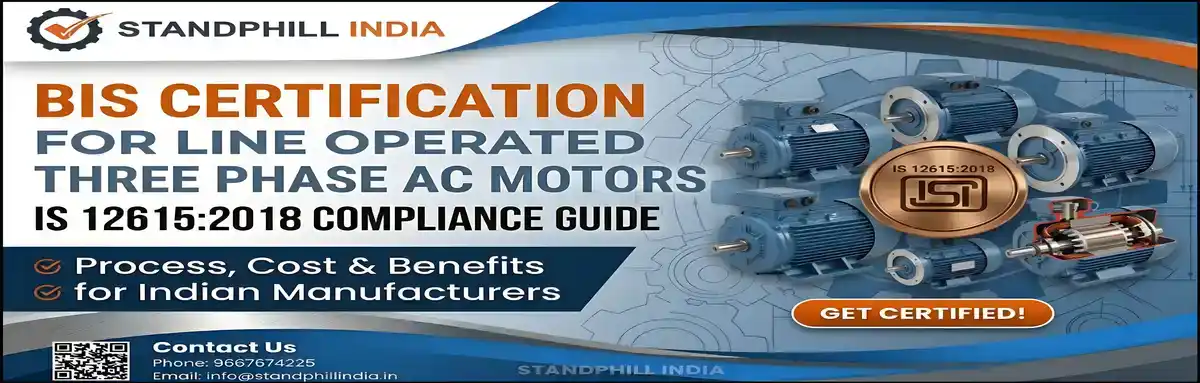
BIS Certification for Line Operated Three Phase AC Motors - IS 12615 : 2018
Complete Guide to BIS Certification for Induction Motors | IE2 IE3 IE4 Efficiency Classes
By Standphill India | BIS Certification Consultants | Updated: 2026
Quick Summary
- BIS certification under IS 12615:2018 is mandatory for three phase squirrel cage induction motors sold in India
- Covers motors with 2, 4, 6, and 8 poles, frame sizes 71 to 315L, output from 0.12 kW to 1000 kW
- Defines efficiency classes: IE2 (High Efficiency), IE3 (Premium Efficiency), IE4 (Super Premium Efficiency)
- Certification requires product testing at BIS-recognized labs and factory inspection by BIS officials
- Non-compliance can result in penalties, product seizure, and legal action under BIS Act
- Expert consultants like Standphill India help streamline the certification process
Introduction — The Motor Behind Every Industry
Walk into any factory, power plant, water treatment facility, textile mill, cement plant, or HVAC system in India — and you will find electric motors running silently in the background, driving pumps, fans, compressors, conveyors, and machines of every kind. Electric motors are so fundamental to modern industry that it is almost easy to take them for granted.
But here is a number that puts their importance into perspective: motor-driven systems account for roughly 70% of all the energy consumed by industry in India. That is an enormous share. And it means that if even a small percentage of India's industrial motors are inefficient — consuming more electricity than they should — the national energy bill goes up significantly, industries pay more than they need to, and the environment bears the cost.
This is exactly the problem the Indian government decided to address — not through suggestions or guidelines, but through a legally enforceable mandatory certification requirement. Today, every line operated three phase squirrel cage induction motor sold in India must carry BIS certification under IS 12615 : 2018 and display the ISI Mark on its nameplate. Without this certification, a motor cannot legally be manufactured, imported, sold, or even stored for sale in India.
If you are a motor manufacturer based in India, an importer of motors, or a foreign motor manufacturer eyeing India's growing industrial market — this guide is written for you. We are going to explain everything clearly and in plain language: what IS 12615 requires, what the certification process looks like step by step, what tests your motors must pass, what documents you need, how long it takes, what it costs, and what happens if you skip it.
Quick Navigation
What is BIS Certification for Induction Motors?
Before we get into the specifics of IS 12615, let's quickly establish what BIS certification actually means in the context of motors.
BIS stands for Bureau of Indian Standards — India's official national body responsible for setting and enforcing quality and safety standards for products. BIS certification for a product means that the product has been independently tested and verified to meet the relevant Indian Standard, and that the manufacturer's production facility has been inspected and found capable of consistently producing products to that standard.
For induction motors specifically, BIS certification confirms three things to every buyer:
- that the motor is energy efficient (meeting the minimum efficiency class required by law)
- that it is safe to operate (meeting insulation, temperature rise, and electrical safety requirements)
- that it performs consistently (meeting all mechanical and electrical performance parameters defined in the standard)
When a motor manufacturer holds a valid BIS license under IS 12615 : 2018, they earn the right to stamp the ISI Mark on every certified motor nameplate along with their unique CM/L license number. That ISI Mark is what industrial buyers, government agencies, and project consultants look for before purchasing a motor.
What is IS 12615 : 2018?
IS 12615 : 2018 is the Indian Standard published by BIS titled "Line Operated Three Phase A.C. Motors (IE Code) — Efficiency Classes and Performance Specification." It is India's primary standard for energy efficient three phase squirrel cage induction motors, and it is aligned with the international standard IEC 60034-30-1 — which means Indian manufacturers certified under IS 12615 are producing motors that meet globally recognized efficiency benchmarks.
The standard serves two core purposes:
- First, it defines the efficiency classification system — sorting motors into categories from IE2 (High Efficiency) to IE4 (Super Premium Efficiency) based on how efficiently they convert electrical input into mechanical output.
- Second, it specifies the minimum performance requirements for each efficiency class — covering electrical performance, dimensional standards, insulation requirements, temperature rise limits, noise levels, and testing methods.
👉 In simple terms, IS 12615 : 2018 is the rulebook that every induction motor sold in India must play by. It sets the floor — the minimum quality and efficiency level that is acceptable — and ensures that every certified motor in the Indian market clears that floor without exception.
Is BIS Certification Mandatory for Induction Motors in India?
Yes, absolutely. BIS certification under IS 12615 : 2018 is legally mandatory for three phase squirrel cage energy efficient induction motors in India. This mandate comes from a specific government order — the Energy Efficient Induction Motors — Three Phase Squirrel Cage (Quality Control) Order, 2017 — issued by the Ministry of Commerce and Industry under the BIS Act. Mandatory compliance has been in effect since 1st January 2018.
Under this Quality Control Order, the following activities are strictly prohibited for non-certified motors:
- Manufacturing three phase squirrel cage induction motors without BIS certification and attempting to sell them in India
- Importing such motors into India without a valid BIS certificate
- Storing, distributing, or selling non-BIS certified motors anywhere in the Indian market
And here is one that surprises many people — any substandard non-compliant motors that have already been manufactured must be destroyed within three months and disposed of as scrap. You cannot simply hold onto non-compliant stock and wait.
The only exception to this mandatory requirement is for motors that are manufactured exclusively for export — provided those motors meet the foreign buyer's standards and are not sold in India.
Which Motors are Covered Under IS 12615 : 2018?
Understanding the exact scope of IS 12615 : 2018 is important before you begin the certification process, because the standard does not cover every type of electric motor — it applies specifically to a defined category. Here is exactly what falls within the scope:
| Motor Type: | Single speed, three phase, squirrel cage induction motors operated directly from the line supply |
| Number of Poles: | Motors with 2 poles, 4 poles, 6 poles, and 8 poles |
| Frame Sizes: | Frame sizes from 71 to and including 315L — covering the vast majority of industrial motor sizes used across Indian industries |
| Output Ratings: | Output ratings as specified in IS 1231 : 1974, covering a range from 0.12 kW to 1000 kW |
| Rated Voltage: | Motors rated up to 1000V — covering the standard 415V, 50Hz industrial supply used across India |
| Duty Type: | Motors designed for continuous duty (S1) or intermittent periodic duty (S3) with a cyclic duration factor of 80% or higher |
| Dimensional Standards: | Motor dimensions must comply with IS 1231, IS 2223, and IS 2254 as applicable, depending on the motor's construction type |
If your motor falls within these parameters, IS 12615 : 2018 applies to it and BIS certification is mandatory before you can sell it in India.
Motor Grouping Parameters — How BIS Classifies Motors for Certification
For the purpose of certification and testing, IS 12615 : 2018 groups motors based on the following parameters. Understanding this grouping is important because it determines how many sample motors need to be tested and what your certification scope will cover.
- Type of Mounting: Motors are classified as foot mounted, flange mounted, or vertical shaft mounted
- Number of Poles: 2, 4, 6, or 8 poles
- Efficiency Class: IE2 (High Efficiency), IE3 (Premium Efficiency), or IE4 (Super Premium Efficiency)
- Degree of Protection: Minimum IP44 or higher — specifying how well the motor is protected against dust and water ingress
- Insulation Class: Class B, Class F, or higher — defining the motor's thermal tolerance
- Rated Voltage: Up to 1000V
- Rated Output: From 0.12 kW to 1000 kW
Important practical rule: At least one motor sample representing each pole type and insulation class combination must be tested. Once tested and certified, those results are considered valid for the complete range of motors within the same group. This means you do not need to test every single motor model individually — strategic sample selection can cover your entire declared scope efficiently.
Understanding the IE Efficiency Classes
The efficiency classification system is at the heart of IS 12615 : 2018, and it is one of the most important things to understand before applying for BIS certification. Your certification will specify which efficiency class or classes your motors are certified under, and this directly determines which markets and applications your motors can serve in India.
IE2 — High Efficiency
IE2 is the minimum acceptable efficiency class for line operated three phase induction motors sold in India. Every motor that is manufactured or imported for sale as a standard line operated motor must meet at least IE2 efficiency requirements. IE2 motors are meaningfully more efficient than older standard motors, consuming less electricity for the same mechanical output and reducing operating costs for the industries that use them.
IE3 — Premium Efficiency
IE3 represents a significant step up in efficiency compared to IE2. These motors are built with more active material — more copper in the windings, higher-quality electrical steel in the core — and manufactured to tighter tolerances. The result is lower energy losses, better performance, and even lower operating costs over the motor's lifetime. IE3 motors are increasingly preferred for new industrial installations, particularly in energy-intensive applications like pumps, compressors, and fans that run continuously at high load.
IE4 — Super Premium Efficiency
IE4 is the highest efficiency class currently defined in IS 12615 : 2018. These are advanced motors with the lowest possible energy losses under the standard — ideal for applications where motors run continuously around the clock at high load factors, and where long-term energy savings are the primary purchasing consideration. IE4 certification is a strong market differentiator, and a certification at IE4 level automatically covers IE3 and IE2 as well.
What About IE1? IE1 (Standard Efficiency) is defined in the standard but is only permitted in India when motors are operated with variable frequency drives (VFDs). IE1 motors cannot be sold as standalone line operated motors for standard industrial applications. If you are manufacturing or importing motors for general industrial use in India, IE2 is the minimum class you must certify under.
What Tests Must Induction Motors Pass Under IS 12615 : 2018?
This is one of the most practically important sections of this guide for motor manufacturers. Before BIS will grant certification, your motors must be tested at a BIS-recognized, NABL-accredited laboratory and the test reports must confirm that all parameters of IS 12615 : 2018 are met.
The tests prescribed under the standard cover a comprehensive range of electrical, mechanical, and safety parameters. Here is what the testing involves:
Labelling and Marking Requirements Under IS 12615 : 2018
Once certified, every motor produced under the BIS license must have its nameplate marked in accordance with IS 12615 : 2018 requirements. The rating plate must clearly show the following information:
This nameplate information is not just a legal requirement — it is what industrial buyers use to verify that a motor meets their procurement specifications. A motor without the ISI Mark and CM/L number on its nameplate is immediately identifiable as uncertified, and no serious industrial buyer in India will purchase it.
The Step-by-Step BIS Certification Process for Induction Motors
Now let's walk through the complete certification process in a way that prepares you for every stage. This is exactly how the process works, explained simply and honestly.
-
1
Compliance Assessment and Scope Declaration
Review your manufacturing capabilities, testing infrastructure, and quality systems against IS 12615 : 2018 requirements. Formally declare which motor models — covering which efficiency classes, pole configurations, frame sizes, mounting types, and insulation classes — you intend to cover under your BIS license.
-
2
Product Testing at a BIS-Recognized Laboratory
Motor samples must be tested at a laboratory that is both NABL-accredited and specifically recognized by BIS for motor testing. Sample selection must cover each pole/insulation class combination in your declared scope.
-
3
Document Preparation and Compilation
Compile all required documents including company registration, factory details, product specifications, manufacturing process documentation, quality control procedures, calibration records, and test reports.
-
4
Online Application Submission on BIS Portal
Submit application through the official BIS portal at manakonline.in with company details, factory information, declared motor scope, all documents, and prescribed application fee.
-
5
BIS Document Scrutiny and Query Response
BIS officers review your application in detail. If they have questions, they will raise formal written queries. These must be responded to promptly with complete and technically precise answers.
-
6
Factory Inspection by BIS Officials
BIS officials physically visit your manufacturing facility to verify everything claimed in your application — factory layout, machinery, testing equipment, quality control records, calibration certificates, and incoming material inspection systems.
-
7
Grant of ISI Mark License
After successful document scrutiny and factory inspection, BIS grants your ISI Mark License with a unique CM/L number. From this point, every motor produced under this license must bear the ISI Mark and CM/L number on its nameplate.
-
8
Ongoing Surveillance and Annual Renewal
BIS conducts periodic surveillance inspections to verify that manufacturing processes and product quality continue to meet IS 12615 : 2018 requirements. Your license must be renewed annually.
Documents Required for BIS Certification of Induction Motors
Here is the complete list of documents you will need to prepare for your BIS ISI Mark application under IS 12615 : 2018:
Company and Legal Documents
- Certificate of Incorporation
- PAN Card
- GST Certificate
- Bank account details
- Registered office address proof
Factory and Infrastructure Documents
- Factory address proof
- Complete factory layout plan
- List of manufacturing machinery
- Equipment specifications
Quality System Documents
- Quality control procedures
- Incoming inspection records
- In-process quality checkpoints
- Calibration certificates
Product and Technical Documents
- Technical specifications
- Dimensional drawings
- Manufacturing process flow chart
- Raw material supplier list
Test Reports
- Valid test reports from BIS-recognized laboratory
- Tests covering all prescribed parameters
- Clear identification of each motor sample
Authorization Documents
- Authorization letter for consultant
- For foreign manufacturers: AIR appointment letter, power of attorney, home country registration
Timeline and Cost of BIS Certification for Induction Motors
Timeline
Cost Components
- Application Fee: Government fee paid directly to BIS when submitting application
- Product Testing Charges: Fees paid to BIS-recognized laboratory for testing motor samples
- Inspection Fees: Charges for BIS officials to conduct factory inspection
- Annual License and Marking Fees: Ongoing costs after certification is granted
- BIS Consultant Fees: Professional charges for managing the certification process
BIS FMCS Certification for Foreign Motor Manufacturers
If you are a motor manufacturer based outside India — in Germany, Italy, China, South Korea, Japan, Taiwan, or anywhere else — you can still obtain BIS certification for your motors through the Foreign Manufacturers Certification Scheme (FMCS). India is too large and too fast-growing an industrial market to leave out of your export strategy, and FMCS is the official gateway.
Under FMCS:
- You must appoint an Authorized Indian Representative (AIR) in India who will represent you before BIS
- Your motors must be tested at a BIS-approved laboratory
- BIS officials will travel to your overseas manufacturing facility for a physical factory audit
- The cost of their travel and stay is borne by you
The typical FMCS timeline for induction motors is 3 to 6 months. It is the most involved of all BIS certification routes, but for serious international manufacturers, it is absolutely achievable — and absolutely necessary for legal market access in India.
Standphill India has guided motor manufacturers from multiple countries through the FMCS process, managing everything from AIR appointment and international lab coordination to overseas factory audit preparation and certificate follow-up.
What Happens If You Sell Motors Without BIS Certification?
Let's be very direct about this because the risk is serious and the enforcement is real.
Under the Quality Control Order, 2017 and the BIS Act, 2016, selling three phase squirrel cage induction motors in India without valid BIS certification under IS 12615 : 2018 is a criminal offense. The consequences are not theoretical — they are actively enforced.
Beyond the legal consequences, the commercial reality is equally unforgiving. Major industrial buyers in India — engineering procurement companies, government agencies, large manufacturers — will not purchase motors without the ISI Mark. Government tenders explicitly require BIS-certified products. And the reputational damage of being caught selling non-certified motors in India is extremely difficult to recover from.
Benefits of BIS Certified Energy Efficient Induction Motors
Getting BIS certified is not just about avoiding penalties. There are genuine, commercially valuable benefits to having your motors ISI Mark certified under IS 12615 : 2018.
Market Access
Legal sale and distribution in India without regulatory risk
Consumer Trust
Industrial buyers prefer certified products
Competitive Advantage
Stand out in a competitive market
Government Tenders
Eligibility for public procurement opportunities
Brand Credibility
Signals quality and reliability to customers
Energy Savings
IE2, IE3, IE4 motors reduce electricity costs for end users
Why Choose Standphill India for BIS Certification of Induction Motors?
Getting BIS certification for induction motors under IS 12615 : 2018 is a detailed, technical, and time-consuming process. The standard itself is technically complex. The testing requirements are rigorous. The factory inspection requires thorough preparation. And for foreign manufacturers, the FMCS process adds an entire additional layer of complexity.
At Standphill India, we have been guiding manufacturers through BIS certification for over 20 years. We have helped 1,000+ brands across India and internationally get BIS certified — across ISI Mark, CRS, FMCS, WPC, PESO, and EPR schemes. And induction motor certification under IS 12615 is one of our core specialisations.
The result is a faster, smoother, and more reliable certification experience — with fewer delays, fewer errors, and a significantly higher first-attempt approval rate.
Frequently Asked Questions — BIS Certification for Induction Motors IS 12615 : 2018
BIS certification under IS 12615 : 2018 is mandatory specifically for line operated three phase squirrel cage energy efficient induction motors with 2, 4, 6, and 8 poles, frame sizes 71 to 315L, and output ratings as specified in IS 1231 : 1974. This mandate is enforced through the Quality Control Order, 2017, with mandatory compliance since 1st January 2018. Both Indian manufacturers and importers of these motors must hold valid BIS certification before manufacturing, importing, or selling these motors in India.
IS 12615 : 2018 is the Indian Standard titled "Line Operated Three Phase A.C. Motors (IE Code) — Efficiency Classes and Performance Specification." It covers energy efficient three phase squirrel cage induction motors with 2, 4, 6, and 8 poles for frame sizes 71 to 315L, with output ratings from 0.12 kW to 1000 kW. It defines efficiency classes IE2, IE3, and IE4, the methods for determining motor losses and efficiency, minimum efficiency values for each class, dimensional requirements, and marking and labelling rules.
IS 12615 : 2018 defines three efficiency classes for line operated motors in India. IE2 is High Efficiency — the minimum class for motors sold for standard industrial use. IE3 is Premium Efficiency — a higher class preferred for energy-intensive continuous applications. IE4 is Super Premium Efficiency — the highest class, offering the lowest energy losses and the greatest long-term energy savings. IE1 motors are only permitted in India when used with variable frequency drives.
Tests required under IS 12615 : 2018 include dimensional verification, measurement of stator winding resistance, temperature rise test, momentary overload test, insulation resistance test, high voltage test, no-load test, reduced voltage running up test, and efficiency measurement using methods prescribed in IS 15999. All tests must be conducted at a BIS-recognized, NABL-accredited laboratory, and results must confirm compliance against all parameters of the standard.
For domestic Indian manufacturers, the BIS certification process under IS 12615 : 2018 typically takes 2 to 4 months from application submission to license grant — assuming complete documentation, satisfactory factory inspection, and conforming test reports. For foreign manufacturers applying under FMCS, the timeline is typically 3 to 6 months due to the additional overseas factory audit requirement. Working with an experienced BIS consultant like Standphill India significantly reduces these timelines.
BIS ISI Mark certification for three phase induction motors under IS 12615 : 2018 is valid for one year from the date of issuance. It must be renewed annually. Renewal requires submitting updated documentation, paying renewal fees, and demonstrating continued compliance with IS 12615 : 2018. BIS may also conduct factory inspections during the renewal process to verify ongoing compliance.
Key documents include the duly filled BIS application form, company registration certificate, PAN Card, GST certificate, factory address proof, factory layout plan, list of manufacturing machinery and equipment, quality control procedures, calibration records, product specifications and technical drawings, manufacturing process flow chart, test reports from a BIS-recognized laboratory, and authorization letter if a consultant is applying on your behalf. Foreign manufacturers additionally need an AIR appointment letter and power of attorney.
Yes. Foreign manufacturers can get BIS certification for induction motors through the Foreign Manufacturers Certification Scheme (FMCS). They must appoint an Authorized Indian Representative (AIR) based in India, get their motors tested at a BIS-approved laboratory, submit a complete application through the BIS portal, and undergo a factory audit at their overseas facility by BIS officials. Standphill India specialises in FMCS certification for foreign motor manufacturers and has helped brands from multiple countries successfully certify their motors for the Indian market.
Under the Quality Control Order, 2017 and the BIS Act, 2016, selling three phase squirrel cage induction motors without BIS certification is a criminal offense. Consequences include heavy fines, imprisonment of up to one year for repeat offenders, seizure of non-compliant motors, mandatory destruction of non-compliant stock at the manufacturer's expense, and public disclosure of license cancellation on the BIS website. BIS actively conducts market surveillance and enforcement actions.
Standphill India manages the complete BIS certification process for induction motors under IS 12615 : 2018 — from compliance assessment and scope declaration to laboratory coordination, documentation preparation, BIS portal submission, factory inspection preparation, BIS query responses, and ongoing compliance management. For foreign manufacturers, we handle the full FMCS process including AIR appointment and overseas factory audit preparation. With 20+ years of experience and 1,000+ successful certifications, Standphill India is India's most trusted BIS certification partner for motor manufacturers. Contact us at +91 96676 74225 or info@standphillindia.in to get started today.
Conclusion — Building Trust Through Compliance
BIS certification under IS 12615 : 2018 is not just a regulatory requirement — it is a strategic asset that strengthens credibility, ensures legal compliance, and opens doors to growth in India's competitive industrial marketplace.
By understanding the process, preparing documentation, and maintaining quality systems, businesses can achieve certification efficiently and build lasting trust with customers.
Working with experienced advisors like Standphill India further simplifies the journey, helping organizations navigate regulatory complexities with confidence.
Need Expert Assistance for Induction Motor Certification?
Contact Standphill India for professional BIS certification support under IS 12615:2018
★ Why Standphill India?
- 20+ Years of BIS Certification Experience
- 10,000+ Certifications Delivered Globally
- Dedicated Teams for CRS, FMCS & ISI Mark
- End-to-End Documentation & Filing Support
- Fast Response & Practical Compliance Guidance
- Support for Indian & Foreign Manufacturers
Get Free Call Back
Our Services
- BIS (ISI Mark) for Foreign Manufacturers
- Domestic BIS (ISI Mark) Certification
- BIS Certificate of Conformity (CoC)
- BIS Hallmarking
- BIS Licence for Toys
- ECO Mark Certification
- TAC Approval for Automobile
- Drug Licence
- Peso Certification
- BIS (CRS) Registration
- WPC-ETA Approval
- BEE Certification
- E-Waste Management (EPR)
- EPR for Plastic Waste
- EPR for Battery Waste
- CE Certification
- UL Certification
- ROHS Licence
- Standardization Division
- Import / Export Licence
- FSSAI Certification
- ISO Registration
- Trademark Registration
- Make in India Support
- AG-Mark Licence
- Third Party Monitoring
Client Testimonials
Their team was very knowledgeable and helped us every step of the way. Standphill India is the best BIS certification consultants for any type of BIS certification.

Chintan Shah (AGM)
Sudeep Nutrition P.Ltd



Featured Guide
Complete BIS CRS certification guide for electronic products in India — free to read.
Read CRS Certification Guide📞 Contact Standphill India
+91-9667674225 info@standphillindia.in WhatsApp Now Greater Noida West, UPGet Expert BIS Certification Support for Your Business
Connect with Standphill India for complete support with BIS certification, CRS registration, WPC approval, FMCS compliance, and related regulatory services. Our team helps businesses with documentation, testing coordination, application support, and end-to-end compliance guidance.
Request Free Consultation
Share your requirement and our team will contact you shortly.