BIS QCO for Copper Products: Complete Compliance Guide
BIS QCO for Copper Products
First, the government brought copper under quality control. Then it got specific - pulling 9 distinct copper products, from the wire rod that feeds India's cable industry to the refrigeration tube inside your air conditioner, under one compulsory order and the ISI Mark.
The Government of India issued the Copper Products (Quality Control) Order, 2024, which superseded the original 2023 order and covers 9 copper products, each tied to its own Indian Standard. If you manufacture, import or sell any of them in India, the ISI Mark is no longer optional - it is the law, and the last compliance window closed on 19 April 2025.
If you make or import copper wire rods, rods and bars, strip, wires, or any of the four notified copper tube categories, this page is for you. We will explain exactly what the order covers, every Indian Standard involved, the one exemption that exists (and the two "exemptions" people wrongly assume), the 2025 amendment most websites have never even read, the penalties, and the smartest way to get certified.
Let us break it all down.
Orders / Notifications
QCO Document
What is the Copper Products QCO?
A Quality Control Order (QCO) is a legal directive issued by the Government of India that makes BIS certification mandatory for specific products. Once a QCO comes into force, those products cannot be manufactured, stocked, sold or imported in India without conforming to the relevant Indian Standard and carrying the BIS Standard Mark (the ISI Mark) under a valid licence.
This particular order - the Copper Products (Quality Control) Order, 2024 - was notified as S.O. 1801(E) on 25 April 2024 by the Ministry of Commerce and Industry (DPIIT), under the powers of Section 16 of the Bureau of Indian Standards Act, 2016. It requires the Standard Mark to be obtained under Scheme-I of Schedule-II of the BIS (Conformity Assessment) Regulations, 2018.
The history matters here. The original Copper Products (Quality Control) Order, 2023 was notified as S.O. 4595(E) on 17 October 2023 and would have come into force six months later. Before that happened, the government superseded it with the 2024 order - keeping the same 9 products and the same Indian Standards, but resetting the compliance clock with fresh staged dates. In effect, the 2024 order acted as an extension. That extension has now fully run out.
Why copper specifically? Because copper is the bloodstream of India's electrical and building infrastructure - power generation, transmission, telecommunications, wiring, plumbing and air-conditioning all run on it. Sub-standard copper means conductors that overheat, tubes that leak inside walls, and refrigerant lines that kill compressors. By bringing these 9 products under compulsory certification, the government closed the door on cheap, unverified imports - and, for honest manufacturers, turned the ISI Mark into both a legal must-have and a passport into serious OEM and infrastructure supply chains.
Which Products Are Covered Under BIS QCO for Copper Products?
The order covers 9 distinct copper products, each mapped to its own Indian Standard exactly as listed in the official Gazette Table. Whatever you make - cast wire rod, busbar stock, seamless tube or drawn wire - it is on this list:
| # | Copper Product | Indian Standard |
|---|---|---|
| 1 | Copper Wire Rods for Electrical Applications | IS 12444:2020 |
| 2 | Copper Rods and Bars for Electrical Purposes | IS 613:2000 |
| 3 | Copper Strip for Electrical Purposes | IS 1897:2008 |
| 4 | Copper Rods and Bars for General Engineering Purposes | IS 4171:1983 |
| 5 | Solid Drawn Copper & Copper Alloy Tubes for Condensers and Heat Exchangers | IS 1545:1994 |
| 6 | Solid Drawn Copper Tubes for General Engineering Purposes | IS 2501:1995 |
| 7 | Copper Tubes for Plumbing | IS 14810:2000 |
| 8 | Wrought Copper Tubes for Refrigeration and Air-Conditioning Purposes | IS 10773:1995 |
| 9 | Copper Wires for General Engineering Purposes | IS 4412:1981 |
One crucial note from the order itself: the latest version of each Indian Standard, including amendments notified by BIS from time to time, applies. Your compliance must always track the current version of the standard - not the one from the day you applied.
And a point that trips up multi-product mills: each row is a separate licence. A producer making wire rod, drawn wire and plumbing tube needs three licences, not one - though the documentation, testing and factory assessment can be intelligently coordinated together.
Implementation Timeline: The Clock Has Already Run Out
The 2024 order came into force on the date of its publication, but gave manufacturers staged conformity dates based on enterprise size:
1. ) General / large & medium manufacturers: compliance mandatory from 19 October 2024.
2. ) Small Enterprises (as defined under the MSME Development Act, 2006): from 19 January 2025.
3. ) Micro Enterprises: from 19 April 2025.
Here is what matters for you in 2026: every one of these dates has passed. The order is now fully in force for all enterprise categories, large and small. There is no transition period left to rely on - if your product is on the list of 9, certification applies to you right now, and every unmarked consignment you ship or import is a live violation.
The BIS certification process - documentation, application filing, factory audit, sample drawal, lab testing and licence grant - has an official standard timeframe of about 30 days for Indian manufacturers with a fully-prepared file, and about 180 days for foreign manufacturers applying through FMCS. Realistically, plan for a few weeks to a few months domestically. Because the deadlines have passed, every month you delay is a month you are exposed.
Our honest advice: start today. Not next month.
The 2025 Amendment Most Websites Never Mention
On 19 February 2025, the government notified the Copper Products (Quality Control) Amendment Order, 2025 - Gazette notification S.O. 884(E). Here is what it actually did, and did not do:
It created a narrow, temporary exemption for one product only: wrought copper tubes for refrigeration and air-conditioning (the IS 10773 product), when imported by a manufacturer for making equipment, sub-assemblies or components in India - and even then only up to 25% of the value of such goods imported in FY 2023–24. The relief existed because India's AC and refrigeration industry depends heavily on imported ACR tube, and domestic certified capacity needed breathing room.
The critical part: that exemption was valid only until 31 March 2025 - it has expired. As of today, no product under the Copper Products QCO enjoys any import exemption. If a supplier or consultant tells you ACR tube imports are still relaxed, they are quoting a dead provision.
Why do we mention an expired amendment at all? Because it tells you two things: the government is actively managing this order (not just filing it away), and the direction of travel is clear - the exemptions get narrower, not wider.
Exemptions: One Real, Two Imagined
This is where the Copper Products QCO is genuinely different from orders like the fasteners QCO — and where costly assumptions happen. The order carves out essentially one exemption:
1. ) Export-only manufacturing - Goods manufactured domestically purely for export are exempt. If it never enters the Indian market, the order does not apply.
Now the two "exemptions" people wrongly carry over from other QCOs:
2. ) "Imported as a component" - NOT exempt here. Unlike the fasteners order, the copper order has no proviso exempting goods imported as part of a finished good or sub-assembly. The only component-import relief that ever existed was the temporary 2025 amendment for ACR tubes — and it expired on 31 March 2025.
3. ) "Small Udyam units" - NOT exempt here. There is no ₹25 lakh investment / ₹2 crore turnover carve-out in this order. Micro and small enterprises were given later compliance dates, not an exemption - and those dates (19 January 2025 and 19 April 2025) have both passed.
One more trap: do not confuse this order with the Copper (Quality Control) Order, 2023 issued by the Ministry of Mines (S.O. 3847(E)) - that is a separate order covering refined copper as a raw material, with its own timeline. The order on this page is DPIIT's Copper Products QCO, covering the 9 downstream products in the table above. If you deal in both cathode-grade copper and manufactured copper products, you may sit under two different orders at once — get your exact position confirmed in writing before you rely on anything.
Penalties: What Happens If You Ignore This QCO?
The Bureau of Indian Standards is the certifying and enforcing authority under this order, and any contravention is punishable under the BIS Act, 2016. The consequences are not symbolic.
Under the BIS Act, manufacturing, selling, storing or importing a notified copper product without the ISI Mark can attract imprisonment of up to two years or a fine of at least ₹2 lakh for the first offence; for second and subsequent offences the minimum fine rises to ₹5 lakh and can extend up to ten times the value of the goods. On top of the monetary penalty comes the operational damage: seizure of non-compliant stock from your factory, warehouse or distributors; customs detention and blocked clearance for importers; and the silent killer - loss of OEM contracts, tenders and institutional customers, who simply cannot buy from an uncertified supplier.
For copper producers especially, this chain reaction is brutal: your buyers - cable makers, panel builders, AC manufacturers, plumbing contractors on government projects - are themselves under compliance pressure. They cannot afford uncertified copper in their supply chain. If you are not certified, you are quietly removed from their approved-vendor lists, and you may never even be told why.
How to Get BIS Certification for Copper Products: Step by Step
Here is what the journey actually looks like:
Step 1 - Map your products to the correct Indian Standards. Wire rod under IS 12444, busbar stock under IS 613, plumbing tube under IS 14810, ACR tube under IS 10773, and so on. Multi-product mills need multiple licences - accurate mapping at the start saves serious time and money later. Watch the boundary lines: electrical-purpose rods and bars (IS 613) versus general-engineering rods and bars (IS 4171) are different licences, as are the four tube categories.
Step 2 - Get your factory and testing setup audit-ready. BIS requires in-house testing facilities as per the applicable standard - chemical composition, resistivity/conductivity for electrical products, tensile, hardness, dimensional checks, and for tubes the deformation and integrity tests (flattening, drift expanding, eddy current, hydrostatic/pneumatic), with calibrated instruments and a quality manual. Gaps in factory readiness are the number-one reason applications get delayed.
Step 3 - Prepare documentation and file the application. Company and factory papers, process flow charts, machinery and equipment lists, calibration certificates, quality-control plans and raw-material test reports - all filed online on the BIS portal in the exact BIS format. Indian manufacturers apply under the domestic ISI Mark (Scheme-I); foreign manufacturers apply under FMCS and must appoint an Authorized Indian Representative (AIR).
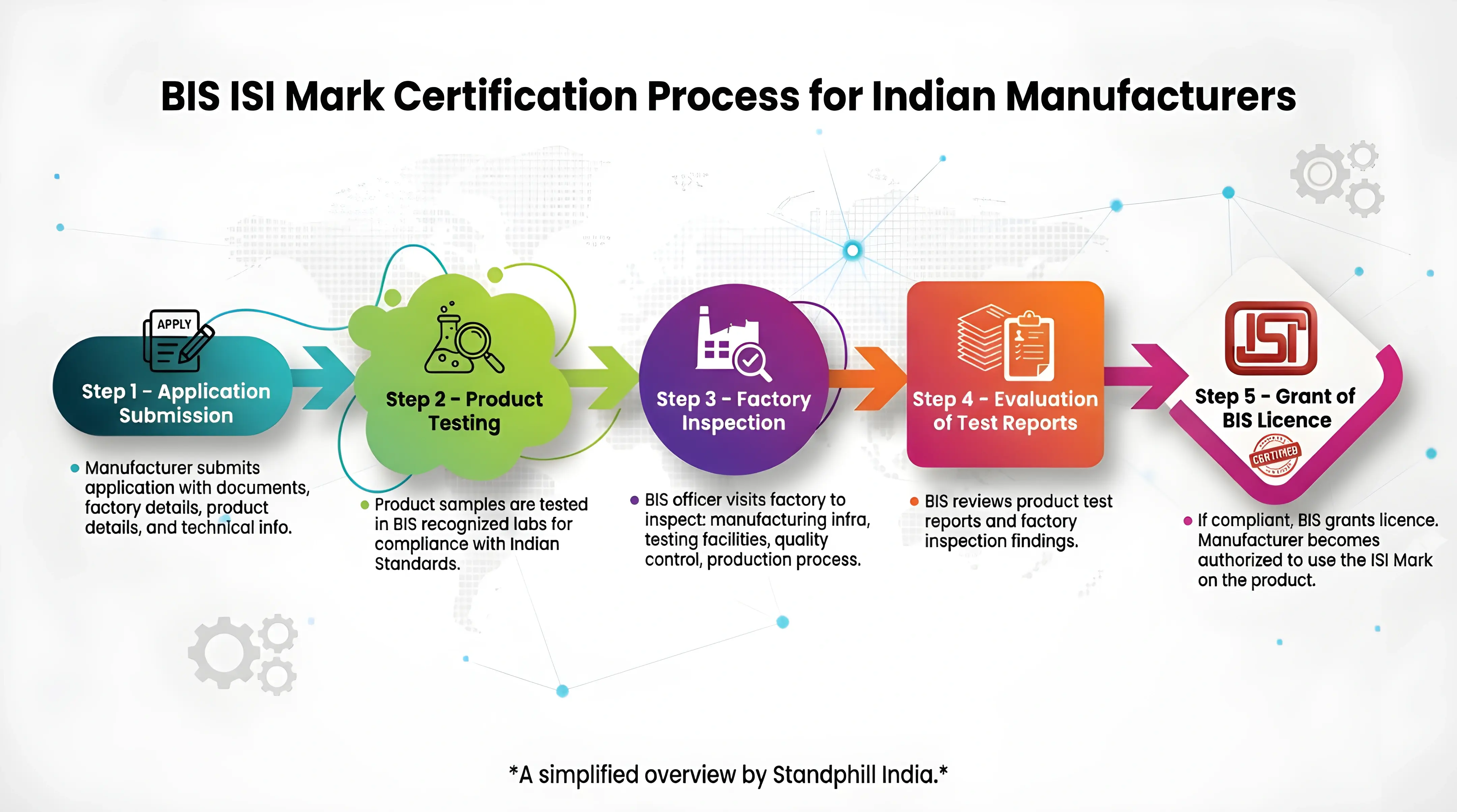
Step 4 - BIS factory audit and sample drawal. A BIS officer inspects your premises, verifies manufacturing and testing capability, and draws product samples.
Step 5 - Independent lab testing. Samples are tested at a BIS-recognised laboratory against the complete requirements of the applicable Indian Standard.
Step 6 - Licence grant and ISI marking. Once reports are satisfactory, BIS grants your licence with a unique CM/L number, and you can start marking your products with the ISI Mark and the licence number.
Step 7 - Stay compliant. Surveillance audits, sample testing and renewals are part of the ongoing journey. Consistent quality is non-negotiable.
Why Early Certification is a Business Opportunity, Not a Burden
Think about what has happened since 19 April 2025, when the last compliance window closed.
Every cable maker, panel builder, transformer manufacturer, AC OEM and plumbing contractor in India now needs ISI-certified copper inputs - because their own compliance depends on a clean supply chain. Cheap, uncertified imported copper gets stopped at customs. The supply of certified material tightens exactly as demand hardens.
Now ask yourself - who wins in that scenario? The mill that got certified early and is sitting ready with the ISI Mark and a clean surveillance record, or the one still waiting for an audit slot while its buyers quietly re-source?
Early movers capture OEM contracts, become preferred vendors for buyers who themselves operate under QCOs, and command better pricing. The order is not just a compliance requirement - for serious copper producers, it is a market-share opportunity dressed up as a regulation.
Here's What Working With Us Looks Like
A free initial assessment to map your exact products to the right Indian Standards - including the tricky electrical-versus-general-engineering and tube-category boundaries. Complete documentation preparation so your application sails through without objections. Factory and in-house lab readiness guidance so you clear the BIS audit in the first attempt. Coordination with BIS-recognised testing laboratories. Full FMCS and Authorized Indian Representative (AIR) support for foreign mills. And continuous follow-up until the licence is in your hand - plus support for surveillance audits and renewals after that.
With 20+ years of experience and 10,000+ certifications across India and abroad, Standphill India has guided everyone from single-product units to multi-standard copper mills through certification - for Indian and foreign makers alike. The compliance dates have already passed, and every month you wait, the queue ahead of you grows longer.
Contact Standphill India today for a free consultation on BIS QCO compliance for copper products - applicable standards, realistic timelines, complete costing - within 24 hours of your enquiry. Call us now or submit an enquiry on our website. Get certified before your competitors do.
Standphill India - Your Trusted BIS Certification Consultant for Copper Products.
Disclaimer
This article is based on the Copper Products (Quality Control) Order, 2024 (Gazette notification S.O. 1801(E), dated 25 April 2024, in supersession of the 2023 order S.O. 4595(E) dated 17 October 2023) and the Copper Products (Quality Control) Amendment Order, 2025 (S.O. 884(E), dated 19 February 2025), as notified by the Ministry of Commerce and Industry, Government of India. Implementation timelines and product entries are stated as per the official Gazette notifications. Standards are subject to the latest versions and amendments notified by BIS from time to time. Readers are advised to refer to the official Gazette notifications and BIS guidelines for exact dates and requirements, as these may be amended from time to time.
Standphill India — Company Profile
Need help with QCO or BIS Compliance?
Connect with our team for guidance on implementation dates, order interpretation, product applicability, and BIS certification.
Get Expert BIS Certification Support for Your Business
Connect with Standphill India for complete support with BIS certification, CRS registration, WPC approval, FMCS compliance, and related regulatory services. Our team helps businesses with documentation, testing coordination, application support, and end-to-end compliance guidance.
Request Free Consultation
Share your requirement and our team will contact you shortly.