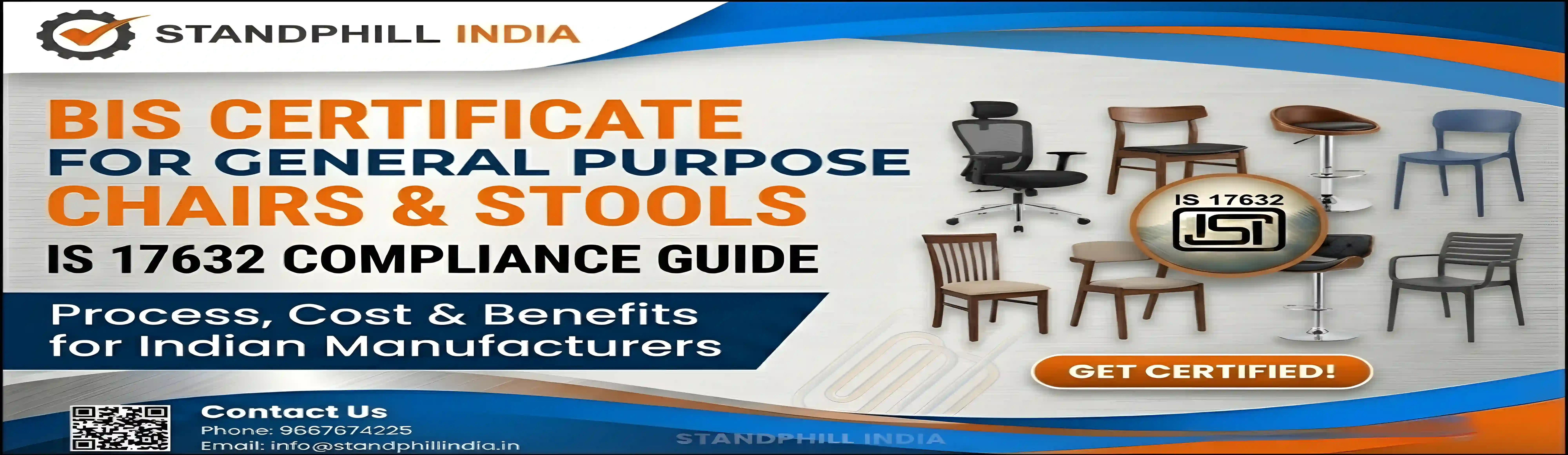
BIS Certification for General Purpose Chairs and Stools under IS 17632:2022
Dining Chairs, Cafe & Restaurant Chairs, Plastic Moulded Chairs, Visitor Chairs, Bar Stools & Kitchen Stools - the ISI Mark Requirement Explained
BIS certification under IS 17632:2022 is mandatory for general purpose chairs and stools - dining chairs, cafe and restaurant chairs, moulded plastic chairs, visitor chairs, bar stools and kitchen stools - under the Furniture (Quality Control) Order, 2025 (S.O. 801(E)), enforced from 13 February 2026 (micro & small enterprises: 13 August 2026). Every unit needs the ISI Mark with a CM/L number, backed by laboratory testing and a factory inspection under Scheme-I. Standphill India manages the entire certification end-to-end. Call +91-9667674225.
Key Facts - General Purpose Chairs & Stools (IS 17632)
- Standard: IS 17632:2022 - chairs and stools for general adult use, domestic and non-domestic; all materials including moulded plastic, wood and metal; fully-made and ready-to-assemble.
- Legal basis: Furniture (Quality Control) Order, 2025 - S.O. 801(E) of 13 Feb 2025; enforced 13 Feb 2026; micro & small enterprises from 13 Aug 2026.
- Boundary: height-adjustable swivel work chairs sit under IS 17631, not here - many seating manufacturers need both licences.
- Volume category: this is the highest-unit-volume category of the QCO - plastic moulded chairs alone sell in tens of millions of units a year in India.
- Amendments: stock window to ~12 Feb 2027 with self-declaration (S.O. 774(E)); import BoL/PO windows closed ~12 Aug 2026 (S.O. 1125(E)); Transition Facilitation pathway added 25 Jun 2026 (S.O. 3417(E)).
- Licence validity: 1 to 5 years per grant, renewable up to 5 years at a time (regulations amended 25 Feb 2026).
Selling Chairs Without a CM/L Number? Your Buyers Are Already Asking For It
Distributors, e-commerce platforms and HoReCa buyers now demand the ISI Mark on chair listings and purchase orders. The MSE compliance date of 13 August 2026 is here - and enforcement for everyone else began in February.
What is IS 17632:2022 and Who Needs It?
IS 17632:2022 - Furniture: General Purpose Chairs and Stools - Specification - is the Indian Standard for everyday adult seating. If beds are the furniture people trust for eight hours a night, general purpose chairs are the furniture people trust hundreds of times a day without thinking about it: the dining chair at home, the stackable banquet chair at a wedding, the moulded plastic chair at a roadside cafe, the visitor chair in a clinic, the bar stool in a restaurant. The standard exists because this is the single highest-volume furniture category in India, and a chair that cracks, tips backward or collapses under a heavier user is both a safety incident and a warranty claim.
Under the Furniture (Quality Control) Order, 2025, every manufacturer and importer of general purpose chairs or stools for the Indian market needs an IS 17632 licence - from the large moulded-plastic chair plants of Gujarat and Maharashtra and the wooden dining-set workshops of Jodhpur and Saharanpur to the cafe-chair importers buying from China, Vietnam and Malaysia who now need FMCS-certified suppliers behind every container.
| Product | General purpose chairs and stools for adult use (all materials) |
| Indian Standard | IS 17632:2022 (latest edition including amendments applies) |
| Certification Scheme | BIS Scheme-I (ISI Mark), Schedule-II, Conformity Assessment Regulations 2018 |
| Governing Order | Furniture (Quality Control) Order, 2025 - S.O. 801(E) |
| Enforcement | 13 Feb 2026 (micro & small enterprises: 13 Aug 2026) |
| Amendments | S.O. 774(E) - 12 Feb 2026 • S.O. 1125(E) - 2 Mar 2026 • Transition Facilitation Order S.O. 3417(E) - 25 Jun 2026 |
| Authority | Bureau of Indian Standards; order issued by DPIIT |
| Marking | ISI Mark + CM/L number on every chair and stool |
Scope of IS 17632 - What Is Covered and What Is Not
The single most common scoping mistake in this category is confusing IS 17632 with its neighbour, IS 17631. The dividing line is simple once you see it: if the chair swivels and adjusts for desk work, it is a work chair under IS 17631; if it is everyday fixed seating, it is here under IS 17632.
| Covered Under IS 17632:2022 | Watch-Outs / Related Standards |
|---|---|
| Dining chairs (wood, metal, plastic, upholstered) • Cafe, restaurant & banquet chairs • Stackable & moulded plastic chairs • Visitor & waiting-area chairs • Bar stools & kitchen stools • Ready-to-assemble chairs (assessed after assembly) | Height-adjustable swivel work chairs - IS 17631 • Chairs with integrated desks/tablet arms - scope confirmation advisable • Children's seating - outside the adult-use scope • Ranked/auditorium fixed seating - confirm scope before applying |
Seating brands very often span both standards - office swivel chairs (IS 17631) plus visitor and cafeteria chairs (IS 17632) - and need a two-licence plan from day one. Get your range mapped free before any sample goes to a lab.
Tests Required Under IS 17632:2022
Chair and stool testing at a BIS-recognised laboratory is a simulation of years of real-world sitting compressed into a test rig. The programme concentrates on strength, stability and fatigue:
| Test | What It Evaluates |
|---|---|
| Design & Workmanship | Construction quality, joints, welds, edges and surface finish per the standard |
| Dimensional Verification | Seat height, depth, width and other dimensions per IS 17632 |
| Seat & Back Static Load | Whether the seat and backrest carry the specified loads without failure or permanent deformation |
| Leg & Arm Strength | Forward and sideways static forces on legs; downward and outward loads on armrests where fitted |
| Stability | Resistance to tipping forward, sideways and - the classic chair failure - rearward when the sitter leans back |
| Seat Impact | Repeated drop impacts onto the seat, simulating a person sitting down heavily |
| Durability Cycling | Tens of thousands of load cycles on seat and back, compressing years of daily use |
Moulded plastic chairs most often fail at rearward stability and seat impact; wooden chairs at joint strength after cycling. Both are usually fixable with small design changes - wall thickness at the seat-leg junction, back-leg rake angle, corner-block reinforcement. We review your design against the standard's pass/fail points before you spend money on testing.
Certification Route - Domestic ISI & Foreign FMCS
Scope
Confirm IS 17632
Documents
BIS formats
Apply
ManakOnline
Testing
BIS-recognised lab
Factory Audit
BIS officer visit
Licence
ISI + CM/L
Indian manufacturers - plastic moulding plants, wooden furniture workshops, metal fabrication units - follow the domestic ISI route on the ManakOnline portal. Under the Grant of Licence Guidelines of 1 August 2025, BIS targets grant within 30 days under Option-2 (report first, then apply) and 90 days under Option-1; a realistic end-to-end plan including testing and the factory inspection is about three months. Full detail: BIS Certification for Indian Manufacturers (ISI Mark).
Foreign manufacturers - chair factories in China, Vietnam, Malaysia, Italy or Turkey - certify through FMCS with a mandatory Authorized Indian Representative, testing to IS 17632, an overseas factory inspection and a USD 10,000 performance bank guarantee; a realistic timeline is around six months. Complete route: BIS FMCS for Foreign Manufacturers.
Once granted, the licence runs for up to five years under the regulations amended on 25 February 2026, and the ISI Mark with your CM/L number goes on every chair and stool. Want to see the licence document itself before you start? View our field-by-field specimen of a furniture BIS licence.
Documents Required for IS 17632 Certification
- Business documents - company registration, GST, legal entity proof (Udyam certificate if claiming MSME benefits)
- Factory layout plan - moulding/fabrication, assembly, finishing and testing areas
- Plant & machinery list - injection moulding machines, wood-working or metal-fabrication lines, jigs and assembly stations
- Raw-material specifications - polymer grades, timber species and moisture specs, steel tube sections, upholstery materials, with supplier test certificates
- Quality control manual and in-process inspection procedures
- Product drawings per IS 17632 for every model and variant, including assembly instructions for ready-to-assemble chairs
- Test reports from a BIS-recognised furniture laboratory
- In-house testing equipment list with valid calibration certificates
Dining Chairs, Plastic Chairs or Stools? Get the ISI Mark Before Your Next Purchase Order Demands It
Standphill India runs IS 17632 certification end-to-end - design review against the standard's pass/fail points, documentation, lab coordination, factory-audit preparation and licence - for Indian and foreign chair makers alike.
Why Standphill India for Chair & Stool Certification
This category punishes casual applications: the volumes are huge, the margins are thin, and a failed stability test on a chair that is already in mass production is an expensive way to learn the standard. As a specialist BIS consultant for furniture, Standphill India reviews your chair designs against IS 17632's specific failure points before testing, prepares BIS-format documentation, coordinates the BIS-recognised laboratory, readies your factory for the inspection and follows the file to your CM/L number - one team, start to licence. We do this for moulders in Gujarat, dining-set makers in Jodhpur, and - through FMCS - chair factories from Guangdong to Northern Italy.
Related Furniture BIS Guides
BIS Certification for Furniture - Complete QCO 2025 + Amendments Guide BIS Certification for Work Chairs (IS 17631) BIS Certification for Tables & Desks (IS 17633) BIS Certification for Storage Units (IS 17634) BIS Certification for Indian Manufacturers (ISI Mark) BIS FMCS for Foreign ManufacturersFrequently Asked Questions - Chairs & Stools BIS Certification
Ask About Chairs & Stools BIS Certification
Tell us your product - we reply with your exact requirement & a quote within one business day.
★ Why Standphill India?
- 20+ Years of BIS Certification Experience
- 10,000+ Certifications Delivered Globally
- Dedicated Teams for CRS, FMCS & ISI Mark
- End-to-End Documentation & Filing Support
- Fast Response & Practical Compliance Guidance
- Support for Indian & Foreign Manufacturers
Get Free Call Back
Our Services
- BIS (ISI Mark) for Foreign Manufacturers
- Domestic BIS (ISI Mark) Certification
- BIS Certificate of Conformity (CoC)
- BIS Hallmarking
- BIS Licence for Toys
- ECO Mark Certification
- TAC Approval for Automobile
- Drug Licence
- Peso Certification
- BIS (CRS) Registration
- WPC-ETA Approval
- BEE Certification
- E-Waste Management (EPR)
- EPR for Plastic Waste
- EPR for Battery Waste
- CE Certification
- UL Certification
- ROHS Licence
- Standardization Division
- Import / Export Licence
- FSSAI Certification
- ISO Registration
- Trademark Registration
- Make in India Support
- AG-Mark Licence
- Third Party Monitoring
Client Testimonials
Their team was very knowledgeable and helped us every step of the way. Standphill India is the best BIS certification consultants for any type of BIS certification.

Chintan Shah (AGM)
Sudeep Nutrition P.Ltd


Featured Guide
Complete BIS CRS certification guide for electronic products in India — free to read.
Read CRS Certification Guide📞 Contact Standphill India
+91-9667674225 info@standphillindia.in WhatsApp Now Greater Noida West, UPGet Expert BIS Certification Support for Your Business
Connect with Standphill India for complete support with BIS certification, CRS registration, WPC approval, FMCS compliance, and related regulatory services. Our team helps businesses with documentation, testing coordination, application support, and end-to-end compliance guidance.
Request Free Consultation
Share your requirement and our team will contact you shortly.